
24/25 vs 25/26: The Data
21 April 2026 · James Robinson
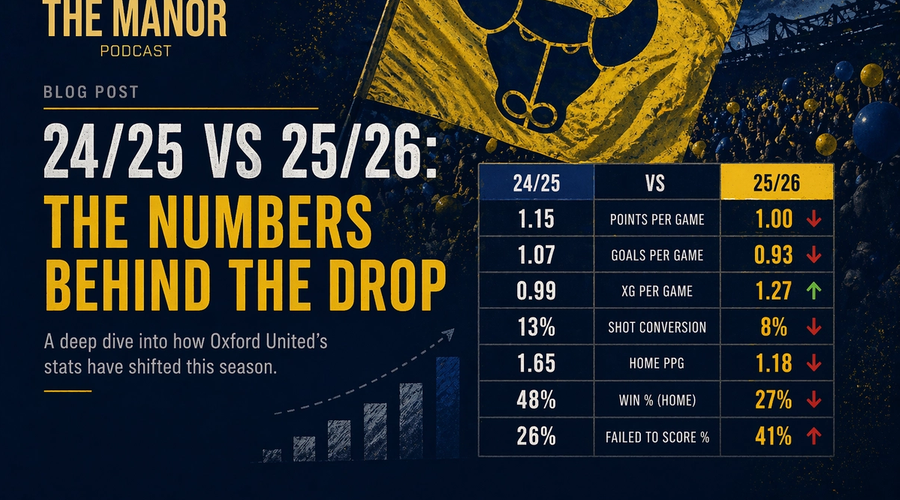
Oxford United’s numbers tell a strange story: improved chance creation, increased attacking intent — and yet a dramatic drop in output. So what’s gone wrong?
24/25 vs 25/26: What’s Changed?
With two games still to play, Oxford United’s 25/26 campaign already tells a clear story: a significant regression from last season, driven less by defensive collapse and more by a blunt attack.
On the surface, the drop-off is obvious. Points per game has fallen from 1.15 to 1.00, wins are down from 13 to 10, and the U’s have slipped from 17th to 23rd. They’ve also scored eight fewer goals. But the underlying numbers paint a more nuanced — and arguably more frustrating — picture.
Attack: More Chances, Worse Finishing
The most striking shift is in the final third. Oxford are actually generating better attacking numbers than last season, with expected goals rising from 0.99 to 1.27 per game, and shots per match jumping significantly from 8.17 to 11.89.
And yet, output has gone the other way.
Goals per game have dropped from 1.07 to 0.93, while the shot conversion rate has fallen from 13% to just 8%. Perhaps most tellingly, the percentage of games in which Oxford fail to score has surged from 26% to 41%.
In simple terms: this is a team creating more, but finishing far less. Whether that’s down to player quality, confidence, or decision-making in front of goal, it’s the single biggest factor behind the downturn.
Defence: Not the Main Problem
Defensively, the picture is far less dramatic. Oxford are conceding fewer goals per game (1.41 down to 1.27), even if the underlying expected goals against has ticked up slightly.
Clean sheets have dropped from 28% to 18%, suggesting a lack of control in games, but overall this isn’t a side being routinely blown away. If anything, the defence has held up reasonably well — certainly well enough that, with average finishing, results could look very different.
Home Form Collapse
If there’s one structural shift that explains the league position as much as anything, it’s the dramatic decline at home.
Last season, Oxford won 48% of their matches at the Kassam Stadium, averaging 1.65 points per game. This season, that’s fallen sharply to a 27% win rate and just 1.18 points per game. Goals scored at home have also dropped significantly.
Interestingly, away form has marginally improved, but not nearly enough to compensate. The result is a side that’s lost its biggest advantage — turning home fixtures from a strength into a weakness.
Style and Control
There are also signs of a stylistic shift. Possession has dipped from 43% to 40%, while shot volume has increased, pointing towards a more direct or transitional approach.
Combined with a slight rise in fouls and a general drop in control metrics like clean sheets, this suggests games have become more chaotic — and perhaps less suited to consistent results.
The Bottom Line
Put it all together, and the story of Oxford United’s 25/26 season is one of contradiction.
The underlying process, particularly in attack, has improved. The team is creating more chances and getting into better positions. But a dramatic drop in finishing efficiency has undermined that progress, turning potential wins into draws and draws into defeats.
Add in a steep decline in home form, and it’s clear why the U’s find themselves in the relegation zone.
In short: better build-up, worse end product — and a season defined by what might have been.
JR